
Biweekly Pay
Pay Structure Guide and Frequently Asked Questions on Biweekly Pay
Why Understanding Your Pay Structure Matters
Workers should understand their pay structure and how their pay is calculated to ensure they are compensated appropriately.
During collective bargaining for the 2025-27 contract, the State proposed transitioning all employees from monthly pay to biweekly pay. Your elected bargaining team reached a Tentative Agreement (TA) with the State that, if ratified, would implement this transition on July 1, 2027.
What are the major pay structure changes?
Below is a summary.
- Starting July 2027, FLSA non-exempt eligible employees will move from a monthly salary system based on projected hours to an hourly system based on actual hours worked.
- All employees will be paid every two weeks on Friday instead of once a month, and the State will use a lag period of 10 weekdays to process payroll accurately.
- As part of the change, eligible employees will receive 40 hours of paid leave (which won’t count toward accrual limits and can be taken as time off or cashed out) and a one-time $1,700 payment, prorated based on FTE.
- To support this transition, a statewide joint labor–management advisory committee will work on issues such as improving the time entry system, creating clear paystubs, developing training programs, and ensuring employees have access to resources like financial counseling.
- Employees will receive training on reading paystubs and entering time, and a payroll assistance team will respond to questions within 24 hours.
- Supervisors will be trained on time approval and payroll processes.
- Safeguards, such as a rapid payroll error response system and access to financial planning resources, will be in place before, during, and after the transition to help employees adjust smoothly.
- From 6 months prior to the transition through 6 months after the transition, employees may utilize their existing pre-retirement planning leave to participate in financial counseling through EAP or to make any necessary financial changes such as contacting debtors to adjust payment due dates or to make changes to current payroll deductions.
What are the issues biweekly pay is meant to address?
The State has been clear that without changes, they can’t fix the ongoing errors and challenges with Workday payroll, which we know are many. They include:
- The State currently pays FLSA non-exempt employees a monthly salary and on actual hours worked. As a result of using two contradictory pay methods for the same workers, the State makes errors that affect the timeliness and accuracy of pay. The transition to only using hourly pay based on actual hours worked for FLSA non-exempt employees is designed to solve this issue.
- The State currently pays employees a monthly salary based on forecasted hours, including hours after the payroll cutoff (usually the last week of the month). Because these hours may not actually be worked – due to absences, leave without pay, work schedule changes, or unentered time – this process may result in overpayments. Forecasting also requires mid-month checks to correct pay for overtime and differentials that weren’t captured before payroll ran. The transition to biweekly pay and using a short lag period is designed to solve this issue because pay will be processed after a payroll period ends, so it can include all time entries, absences, overtime, and differentials for that period, eliminating the need for projecting hours.
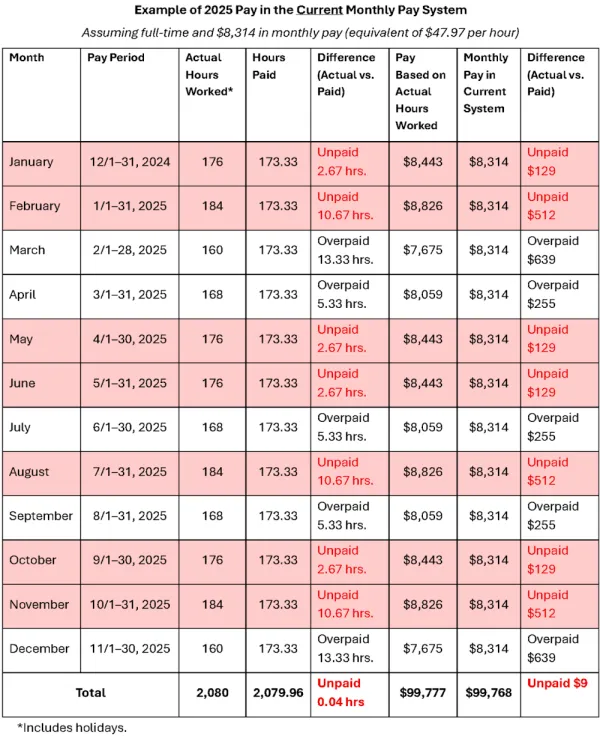
- The State bases monthly salaries on an average of 173.33 hours worked, regardless of the actual number of hours worked in the month. This means that in some months, monthly paychecks underpay the actual number of hours worked. See “What does the payroll transition look like in an example?” for an illustration of this.
What does the pay structure transition look like in the TA?
After months of bargaining, the transition plan is:
- Move payroll to a biweekly schedule starting in July 2027, with the final full-month paycheck on July 1, 2027.
- To help with the transition you will receive both:
- 90 days prior to the transition 40 hours of paid leave, which can be cashed out immediately and won’t count toward accrual limits.
- On July 1, 2027, a one-time $1,700 paycheck, prorated based on FTE. Your bargaining team successfully increased this amount from management’s original proposal of only $500.
- Pay for the partial month before biweekly pay begins (July 1-3, 2027) will be paid out on July 16, 2027. This payment is based on an average of two full workdays, assuming a Monday–Friday schedule. For example, a full-time worker would typically work 16 hours on Thursday, July 1 and Friday, July 2, and not work on Saturday. The payment is prorated based on the usual weekly hours value. Workers who do work on Saturday, July 3 will receive a higher payment to reflect those additional hours.
- Biweekly pay periods begin with the July 4-17, 2027 pay period which is paid out on July 30, 2027.
Here is a full breakdown of the pay periods and paydays in 2027 during and after the transition:
Pay Date | Pay Period | Hours for FT Employee | Notes |
July 1, 2027 | Final Full Month Pay (for June 2027) | — | Last monthly paycheck |
July 16, 2027 | Partial Month’s Pay, July 1 – July 3 | Avg. 16 hours | Short period between monthly and biweekly schedule |
July 30, 2027 | July 4 – July 17 | 80 hours | First biweekly pay period |
August 13, 2027 | July 18 – July 31 | 80 hours | |
August 27, 2027 | August 1 – August 14 | 80 hours | |
September 10, 2027 | August 15 – August 28 | 80 hours | |
September 24, 2027 | August 29 – September 11 | 80 hours | |
October 8, 2027 | September 12 – September 25 | 80 hours | |
October 22, 2027 | September 26 – October 9 | 80 hours | |
November 5, 2027 | October 10 – October 23 | 80 hours | |
November 19, 2027 | October 24 – November 6 | 80 hours | |
December 3, 2027 | November 7 – November 20 | 80 hours | |
December 17, 2027 | November 21 – December 4 | 80 hours | |
December 31, 2027 | December 5 – December 18 | 80 hours |
What other changes are in TA that would affect my pay leading up to the payroll transition?
In addition to the 40 hours of cashable paid leave and a one-time $1,700 paycheck prorated based on FTE, your bargaining team won:
- COLAs totaling more than 5% over the life of the contract. This will include a 2.5% COLA on February 1, 2026 and 4% on January 1, 2027.
- Steps increases allowing non-topped out workers to receive steps as scheduled and a new (11th) top step on February 1, 2027. Employees who have been with the State for 10 years and are topped out will receive their new step immediately on that date.
What does the current payroll structure look like in an example?
A full-time worker will work 2,080 hours in a year (40 hours × 52 weeks). The State currently divides this evenly across the year, assuming 173.33 hours per month (2,080 ÷ 12 months), and uses that figure to calculate monthly pay. Sometimes that means workers are overpaid in a month and sometimes it means they are underpaid. Depending on the year they might be underpaid for the year, based on the hours worked.
For example, let’s look at a full-time Paralegal, Step 10 in Salary Range 26 of the Strikeable Unit. Their base monthly salary is $8,314, based on full-time work (40 hours per week, FTE 1.0). **This is for illustrative purposes only.**
The monthly base salary of $8,314 covers 173.33 hours, regardless of the actual number of hours worked in the month. This equates to an hourly rate of approximately $47.97 ($8,314 ÷ 173.33).
This also means that even if there are more working hours in a given year, a worker is only compensated for 2,080 hours annually.
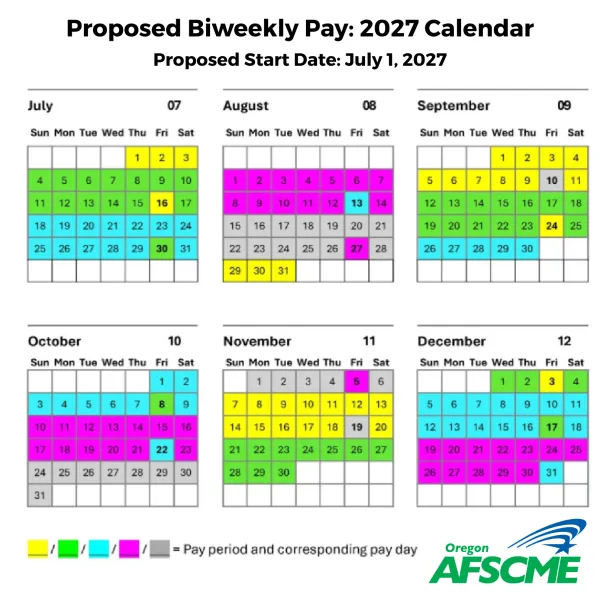
Ex. July 1 – July 3 paid on July 16, July 4 – July 17 paid on July 30, July 18 – July 31 paid on August 13
Frequently Asked Questions
Q: What will my pay actually look like in the new payroll structure?
A: Starting July 2027, your pay will be issued every two weeks instead of once a month. If you’re FLSA non-exempt, you’ll be paid based on actual hours worked rather than projected hours, which should improve accuracy and reduce payroll errors. Your total compensation won’t change, but each paycheck will be smaller and more frequent.
You’ll receive 26 paychecks per year, and some deductions (like union dues and PERS) and payroll taxes are likely to be evenly split between paychecks. Everyone’s pay will look a bit different depending on hours worked, FTE, deductions, and taxes. A one-time $1,700 payment (prorated by FTE) and 40 hours of paid leave will help with the transition.
To see how your gross pay might look under the new system, click here to use the calculator our sibling union SEIU has created to see what your new gross pay might look like under the new system.
Q: What does biweekly pay mean?
A: All employees will be paid every two weeks on Friday instead of once a month, and the State will use a lag period of 10 weekdays. For example, the first biweekly pay period in 2027 runs from Sunday, July 4 to Saturday, July 17, and the actual hours worked during this period are paid out on Friday, July 30.
Q: How do projections cause problems?
A: Current payroll is based on projected hours, which can cause over- or under-payment when actual hours differ from projected hours. This commonly happens when people end up taking leave without pay at the end of the month, when they have already projected work hours.
Q: How will hourly pay help?
A: Hourly pay ensures you’re paid for actual hours worked, reduces payroll errors, and improves accuracy. It’s not common for FLSA non-exempt workers to be paid as salaried workers, so there is a heightened possibility for errors from third party payroll systems like Workday.
Q: How will my hourly rate of pay be calculated?
A: An employee’s hourly rate will be determined by the following:
Monthly salary * 12/ 2080 hours= hourly rate of pay.
Q: Will the transition affect my FTE status?
A: No. We specifically have contract language that protects workers from those changes.
Q: What if I don’t submit my timesheet on time? What if my manager doesn’t approve my timesheet on time?
A: Management is responsible for tracking time, approving timesheets and ensuring workers are paid, even when time is not submitted or approved on schedule.
Q: Will my total pay change with biweekly pay?
A: No. Your total compensation will remain the same. You will still receive the two COLAs that apply to everyone, and if you are eligible for step increases (meaning you are not already at the top step), you will continue to receive them. Employees who are currently at the top step will also receive a new top step as part of the TA. The only change is that your pay will be split into smaller amounts and issued more frequently, every two weeks instead of monthly.
Q: How many paychecks will I get each year?
A: Under a biweekly system, you will receive 26 paychecks per year instead of 12.
Q: Will my paycheck amount be smaller?
A: Yes, each paycheck will be smaller than your monthly paycheck, but you’ll be paid more frequently. No one will receive a decrease in compensation because of the changes.
Q: How will deductions for benefits work?
A: Some of this is still being worked out. The committee we bargained will work with management on this over the next year. We expect most deductions (union dues, retirement contributions) will be split evenly across your biweekly paychecks. Healthcare will be deducted with your first two paychecks in a month. In months with three paychecks healthcare premiums will not be withheld.
Q: How will this affect my budgeting?
A: Since pay will come every two weeks instead of once a month, you may need to adjust how you manage recurring bills and savings. Some months will have three paychecks instead of two. To support this change, the TA includes access to free financial counseling resources before and after the transition. These services can help you review your budget, adjust payment due dates, and create a plan for managing your money under the new pay schedule.
Q: Will my direct deposit be affected?
A: No.
Q: What happens during the transition month?
A: The transition to a biweekly schedule will begin in July 2027, with the final full-month paycheck on July 1, 2027.
- To help with the transition, on July 1, 2027,you will receive both:
- 40 hours of paid leave, which can be cashed out immediately and won’t count toward accrual limits.
- A one-time $1,700 paycheck prorated based on FTE. Your bargaining team successfully increased this amount from management’s original proposal of only $500.
- Pay for the partial month before biweekly pay begins (July 1-3, 2027) will be paid out on July 16, 2027. This payment is based on an average of two full workdays, assuming a Monday–Friday schedule. For example, a full-time worker would typically work 16 hours on Thursday, July 1 and Friday, July 2, and not work on Saturday. The payment is prorated based on the usual weekly hours value. Workers who do work on Saturday, July 3 will receive a higher payment to reflect those additional hours.
- Biweekly pay periods begin with the July 4-17, 2027, pay period which is paid out on July 30, 2027.
Q: Will my overtime and differential pay be paid faster?
A: Yes. Overtime and differential pay will be calculated within each two-week pay cycle and included in your next paycheck, rather than waiting until mid-month for a separate corrective paycheck.
Q: Will overtime taxes still be withheld at a different rate than my regular paycheck?
A: No. Moving to biweekly pay addresses that issue as the payroll system will not see overtime checks as different from regular paychecks. That issue should be fixed by this transition.
Q: Will holiday pay be handled differently?
A: No. Paid holidays will still be credited as hours worked within your pay period and compensated accordingly.
Q: How will leave accrual and balances be affected?
A: Leave accruals also still need to be worked out. There are numerous ways that it can be accrued and we are still working on figuring out what is most advantageous to workers.